Guide

Most people don't know what yimyu is.
There are a lot of misconceptions surrounding yimyu, even in Taiwan. Yimyu is not another term for soy sauce paste, nor is it made exclusively from black soybeans – it can also be made with chamame beans or yellow soybeans as well. The important thing about yimyu is that no wheat or wheat-based ingredients are used at any point in the brewing process – if both soybeans and wheat are used, it becomes part of the Japanese-style shōyu (soy sauce) family.
One of the best things about Taiwanese yimyu is that it’s gluten-free, making it suitable for people with wheat allergies!
So, what exactly is yimyu?
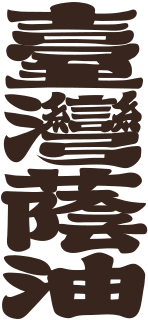
Yimyu is a type of soy sauce – specifically, a type of traditional Taiwanese soy sauce. Since the end of 2016, we’ve been documenting yimyu breweries all over Taiwan and hearing the perspectives of many veterans in the trade. The most reasonable explanation we’ve found comes from Mr. James Tu, the owner of Heilong Yimyu: the word 「蔭」 (the 'yim' in 'yimyu') originally referred to the act of heating something in a sealed environment. Over time, yimyu has come to broadly refer to soy sauce formed under high-temperature sun exposure.
In short: yimyu is soy sauce made from whole soybeans, placed in a vessel and sun-aged to maturity.
Let's take a tour of an yimyu factory!
Before we go in, you'll need to open up four of your senses – sight, smell, taste, and finally, your sense of curiosity!
This is the koji chamber, where we make the starter culture. Hold on a moment – let me lift this cloth. Do you see the white stuff on the bamboo trays? That’s the koji mold beginning to grow. Can you smell anything in the air?

When the koji mold is inoculated well, you’ll catch a faint herbal, grass jelly-like aroma. But if the fermentation temperature isn’t well controlled and stays above 38°C for too long, you'll notice a strong smell of ammonia instead.
Don’t worry, though – in Taiwan, it's rare for the fermentation process to fail. Taiwan truly is a brewer’s paradise: located right along the Tropic of Cancer and surrounded by the ocean, it has just the right warmth and humidity for fermentation to take place. As long as the soybeans are cooked just right, the koji will grow beautifully – and with good koji, you can make excellent yimyu.
After about four to seven days, well-fermented koji will be just like a newborn chick – full of life and energy.

Now let me take you to our most picturesque spot – the jar-field.

In these rows, there are over 100 ceramic jars. Each one holds fermenting soybeans. Try touching one of them – can you feel that warmth? That’s the sun at work. Sun exposure is what gives Taiwanese yimyu its unique flavor. Without the sun, the flavor would be completely different.
Now, let’s lift the lid off one of these jars. Take a look at the crystals forming on the surface. Then, smell the air around it, and tell me: based on the aroma, do you think those crystals are salt or sugar?

Most of you probably said sugar, right? But, actually, this was a trick question! Yimyu needs salt to control the fermentation process – that's what those crystals are.
But don't worry – there's nothing wrong with your nose. During this process, the yimyu really does let off a 'sweet' aroma.
In fact, it's not just humans that get fooled by this process. When the liquid inside the clay jars matures and we brush away the layer of salt crystals on top, the aroma of the raw yimyu often attracts bees. So, even bees mistake that rich, mellow fragrance for something sweet!
In the past, there was a soy sauce brewery in Huwei, Yunlin, called Jinbo Soy Sauce, which locals affectionately called the 'butterfly brand.' Their name came from the fact that, after their yimyu matured, butterflies would gather around their jars – a sign of nature’s approval!

Although yimyu smells sweet, as you can see from the salt crystals on top, it actually tastes quite salty when sampled directly. Its true flavor unfolds as 'salty first, followed by umami.'
Many people mistake this umami flavor for the kind of sweetness you get from sugar. But that’s not quite right – if a soy sauce tastes overtly sweet, it's usually because flavor enhancers or large amounts of sugar have been added to it separately.
What is 'umami'?
When you taste yimyu, the salty flavor lingers in your mouth for about a minute. Once that saltiness fades, what remains is a kind of 'sweet' aftertaste – like the kind you get from drinking tea, where your mouth feels refreshed and moist rather than thirsty.
In fact, this isn't true sweetness but the flavor of 'umami.’ It’s caused by the amino acids in protein breaking down and activating your tastebuds.

Now, we’ve arrived at the simmering area.

It’s hot here in the summer, but in winter it feels wonderfully cozy. Knowing you were coming today, we started simmering the yimyu at 8 a.m. – now, the pot is almost at a boil. But the real aroma hasn’t fully emerged yet.
Taiwanese yimyu is special in that, unlike Japanese shōyu (soy-wheat soy sauce), its fragrance only develops after boiling.
The aroma of Japanese shōyu comes mainly from starches that break down into ethereal, wine-like fragrances – similar to the scent of light sake. That’s why shōyu should not be boiled for too long, or its fragrance will dissipate. For instance, when ordering soy-sauce ramen, the chef will only add the shōyu to the broth right before serving it. This is so that the delicate aroma will be preserved.
Taiwanese yimyu, on the other hand, is made from whole soybeans. Its fragrance comes from esters, similar to the fragrance of natural oils. These aromas intensify with heat, which is why yimyu actually becomes more fragrant when brought to a boil. It also makes yimyu ideal for long, slow cooking, and it can even be reheated repeatedly. That’s why master stock for Taiwan's stewed dishes is often made with yimyu.
Moreover, high-concentration varieties like jar-bottom yimyu are so rich that they can even serve as soup bases, completely replacing store-bought chicken bouillon or bone stock. They also pair especially well with napa cabbage, tomatoes, and meat dishes.
When cooking soup with yimyu, don't think of it as 'drinking soy-sauce water.' Adding yimyu isn’t about chasing a strong soy-sauce taste – it’s about using just the right amount to bring out an all-new, delicious layer of flavor. For example: add just 10–15 ml of jar-bottom yimyu to a pot of Chinese cabbage and simmer for 30 minutes – the result tastes just like chicken soup!

That’s it – now, get ready to dive in! On this platform, you’ll find a selection of yimyu from various manufacturers across Taiwan, each one crafted with different brewing methods and offering its own unique flavor profile. Find one that catches your eye and give it a taste!
If it’s your first time buying yimyu, think of the flavor in terms of four quadrants based on aroma intensity and balance of saltiness and sweetness. Yimyu brewed using water fermentation, wet fermentation, and post-fermentation reduction methods tend to have lighter, more delicate aromas. Meanwhile, dry-fermented and double-fermented varieties are richer and more full-bodied. The level of saltiness or sweetness varies by brand – you can refer to each producer’s 'Flavor Radar Chart' or 'Salty-Sweet Rating' for details.
With the help of this platform, I hope you’ll discover an yimyu flavor that truly resonates with you and helps shape your own unique taste.
Thanks for taking the time to learn about yimyu, and good luck on your culinary voyage!

Find on Map
Find by Recipe